David beckham's wife Victoria posts picture and Twitters that a UFO hovered over her Los Angeles home

David beckham's wife Victoria posts picture and Twitters that a UFO hovered over her Los Angeles home ....

Federal authorities to shut off all TV and radio communications simultaneously 11/9/11 at 2PM ET

If you have ever wondered about the government’s ability to control the civilian airwaves, you will have your answer on November 9th.

The Coming Derivatives Crisis That Could Destroy The Entire Global Financial System

Most people have no idea that Wall Street has become a gigantic financial casino.

5 to 6 Thousand Dead Birds wash ashore at Wasaga Beach, Canada

Thousands of dead birds have flooded the shores of Georgian Bay in a scene that locals compared to the devastation from an oil spill.

UFO over Sioux Falls? Experts think it was a meteor

Amie Neustrom doesn't have a good explanation for what she saw in the night sky near her Renner home early Wednesday.

RT AMERICA

Showing posts with label EARTH CHANGES. Show all posts

Thursday, November 17, 2011

Restless underwater volcano disrupts life on Canary Island

© Guardia Civil
Madrid - Steaming magma is bubbling onto the sea surface. The earth shakes, and a smell of sulphur floats in the air.

For over a month, residents of the Spanish Canary Island of El Hierro have lived with an active underwater volcano that not only poses a security threat, but also scares off tourists and endangers the inhabitants' livelihoods.

Volcanic eruptions could continue for weeks, civil protection science representative Carmen Lopez said this week.

However, the situation has been deemed safe enough for the 550 evacuated residents of the fishing village of La Restinga to return home, though the island was still being hit by earthquakes.

The earth began trembling on El Hierro on July 19, in a sign that magma was rising toward the surface of the smallest Canary Island.

Evacuation

The island of 11 000 residents has a large volcano and more than 250 craters. But its volcanic power had been dormant for centuries, with the last eruption reported in 1793.

El Hierro has now experienced more than 11 000 earthquakes since July. The vast majority were not noticed by the population, but grew in intensity.

Dozens of people were evacuated for fear of rockslides in September, and an army unit was put on standby to help in the event of a mass evacuation.

An underwater eruption occurred on October 10, following an earthquake of a magnitude greater than 4. Scientists observing seismic activity confirmed the eruption. Dead fish were seen floating on the water.

Volcanic activity has since continued intermittently, with witnesses reporting jets of gas and ash spewing several metres above sea level.

The eruptions have sent a large volume of greenish magma spilling into the sea.

An oceanographic vessel discovered a 100m-high volcano with a 120m-diameter crater located at a depth of about 200m.

Eruptions

It is thought possible that magma is also breaking through one or two other outlets. Some of the eruptions have been observed as close as 1.5km off El Hierro's southern coast.

The nearby La Restinga has been evacuated several times. There has also been concern over a possible eruption off Frontera, the island's economic capital in the north, following strong earthquakes in the area. More than 50 people were evacuated.

"The worst scenario would be an eruption on land," Canaries security chief Juan Manuel Santana told the daily El Pais.

There is even a remote possibility of eruptions resulting in new land. Possible names for a new Canary Island have already been suggested on the internet, such as Atlantis or Discovery.

For the moment, however, experts are most concerned about the presence of toxic gases, though there is practically no evidence so far of health damage to the population.

Most El Hierro residents are more worried about their livelihoods than about the simmering volcano.

Emergency

The earthquakes and eruptions have brought fishing and touristic diving to a standstill in La Restinga, some of whose residents had to resort to emergency food aid.

Life is now returning to the village while two nearby coves still remain closed to the public.

The authorities are also maintaining some of the traffic restrictions imposed earlier. Traffic will remain limited in a key tunnel linking Frontera with the island's capital Valverde. The traffic problems have sparked more protests over economic losses.

There were initial hopes that the volcano would draw more tourists to the island, which receives about 7 000 visitors annually.

But the opposite happened, with more than 1 500 cancelling their holidays and causing losses worth hundreds of thousands of euros for the local tourism industry, its representatives said.

Magma now covers some of the island's rich underwater flora and fauna at the Mar de las Calmas marine reserve, which was a favourite among tourists.

Some El Hierro residents are preparing demonstrations, accusing Prime Minister Jose Luis Rodriguez Zapatero's government of abandoning them.

"Other emergencies only last a certain time, but that is not the case now," Santana said. "What people want is a return to normality, to routine."

Monday, November 14, 2011

Canada: British Columbia storm cuts power, jams highways, stops ferries

Canada: British Columbia storm cuts power, jams highways, stops ferries


CBC News
Fri, 11 Nov 2011 11:06 CST
Print
© CBC News
Stormy weather has forced BC Ferries to delay ferries on several routes on Friday afternoon, cut power to thousands and caused havoc on the Coquihalla and other B.C. highways.

Shortly after 2 p.m. BC Ferries began announcing ferries would not be sailing between Vancouver and Vancouver Island, and on several smaller routes until high winds subsided.

About 50,000 BC Hydro customers in the Lower Mainland, the Sunshine Coast and Vancouver Island regions were without power as the wind knocked trees onto power lines during the height of the storm around 3 p.m.

Then by 3:30 p.m. the wind had subsided in some areas and some of the ferries had resumed sailing, including those on the Tsawwassen to Swartz Bay route, but sailings on many routes were running behind schedule.

The storm also brought heavy snow to the Coquihalla Highway and officials were warning drivers not to use the route because of the dangerous winter driving conditions and the large number of vehicles spinning out in the snow.

Winter driving conditions are also impacting several other B.C. interior highways including Eagle Pass and Rogers Pass on Highway 1, and Pine Pass on Highway 97, and Kootenay Pass and Alison Pass on Highway 3, according to Drive B.C.

Severe weather warnings have also been issued for Vancouver, Pitt Meadows and White Rock, where winds of up to 90 km/hr are forecast for Friday afternoon and evening.


Tourists invited to see erupting Congo volcano

Tourists invited to see erupting Congo volcano

Sayyid Azim / AP
In this Sunday, July 28, 2002 file photo, plumes of lava spew high into the air from Mount Nyamulagira, near the town of Goma in eastern Congo.
By
updated 11/14/2011 11:41:39 AM ET

A national park in Congo best known for its endangered mountain gorillas is now inviting tourists to go on overnight treks to see a volcano spurting fountains of lava nearly 1,000 feet into the air.

Mount Nyamulagira began erupting on Nov. 6 and could continue to do so for days, or even months.

"Last night's was the most spectacular yet," spokeswoman LuAnne Chad said Monday from Virunga National Park.

Hawaii's Kilauea Volcano attracted tourists earlier this year when a fissure had lava spurting 65 feet (20 meters) high. In comparison, volcanologist Dario Tedesco estimated that the lava on Mount Nyamulagira in Congo is spewing up to 980 feet high (300 meters) high.

Park wardens have named the latest Nyamulagira eruption "Kimanura," after the name of the area along the volcano's flank, spokeswoman Chad said.

Rivers of incandescent lava are flowing slowly north into an uninhabited part of the park, but that the lava flows pose no danger to the park's critically endangered mountain gorillas, a statement from the park said.

Virunga Park is home to 200 of the world's 790 mountain gorillas, as well as lowland gorillas, chimpanzees, okapi, forest elephants and buffalo.

The park has set up a tented camp nearly one mile (1.5 kilometers) south of the eruption where tourists can spend the night. For $300, the park provides transportation for the hour-long drive from the eastern capital of Goma and wardens to guide visitors on the three- to four-hour hike to the camp.

Virunga is located in eastern Congo, where numerous militia and rebel groups continue to terrorize the population nearly a decade after the country's civil war ended. Some 360 park rangers protect the park and its wildlife from poachers, rebel groups, illegal miners and land invasions.

Rangers worked through the civil war in eastern Congo's five parks, with more than 150 killed in the last 10 years, according to the statement.

The 3,000 square-mile (7,800 square-kilometer) Virunga National Park is a World Heritage site containing seven of the eight volcanoes in the Virunga mountain range that sprawls across the borders of Congo, Rwanda and Uganda. Only two are active — Nyamulagira and, closer to Goma, Mount Nyiragongo.

Nyiragongo erupted destructively in 2002, destroying most of Goma city including 14,000 homes and forcing 350,000 residents to flee.


Sunday, November 13, 2011

Dalton, Georgia Reacts to 2.7 'Tremor - explosion, came from the air

Dalton Reacts To 2.7 Tremor


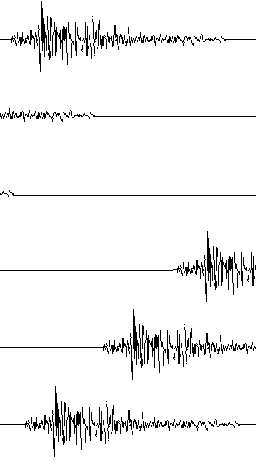
A 2.7 magnitude quake rocked the Dalton area just before noon Wednesday. While some people in Dalton were pretty sure the rumble was an earthquake, others were convinced it was something else.

"Chances are it might have been an earthquake, but maybe it was some big monster outside that's coming to get us all," Jonathan Marks jokes about the magnitude 2.7 quake, but he wasn't the only one who was curious about what caused the ground to shake beneath his feet. The US Geological Survey didn't officially deem the shake, a quake until 2 hours after people say they felt the ground rattle and heard a loud boom in the air.

"I thought it was kind of like a huge explosion or a sonic boom because there was a little noise at first and then a loud explosion and I felt it right between my shoulders it was like it come from the air," said Mary Ellen Gurley, an employee at Dalton State College.

CLICK HERE to listen to 911 calls place immediately following the quake.

The USGS says Northwest Georgia is not an area prone to quakes. The largest earthquake in our seismic zone was on April 29th, 2003. It was a 4.6 magnitude near Fort Payne, Alabama. So if you had never felt one until Wednesday, you probably wouldn't have known what it was.

"I lived in North Carolina several years ago and felt one there. I guess it's not that different from a sonic boom or an explosion or something but to me, I thought this one was an earthquake, I guess having felt it before," said Mike Brown from Dalton.

Though the Dalton Police Department was flooded with calls, luckily no one was injured in the quake.

According to the USGS, the closest, most recent earthquake besides this one, happened Tuesday. A 2.0 magnitude earthquake hit Maryville, Tennessee around 8:30 p.m.

El Hierro Underwater Volcano's Eruption in Photos

El Hierro Underwater Volcano's Eruption in Photos

A brand new Canary island is emerging from the sea as an underwater volcano bubbles to the surface.

A brand new Canary island is emerging from the sea as an underwater volcano bubbles to the surface.

Magma off the Canary Island of El Hierro has been spewing 20 metres high as the sea boils with a smell of sulphur.

As it grows and gets closer to the surface, more and more debris such as stones start to shoot out of the volcano which, until now, has only shown its explosive power below the surface.

It is now just 70 metres from the surface and islanders are already trying to come up with a name for the new island. It is quite close to El Hierro and if it continues to erupt it could eventually meet up with the mainland.


It's not known at this point whether Ryanair, famed for flying to out-of-town airports, plans on opening up a route to the new-born island.

Homes have been evacuated and roads closed on the southern-most Canary Island following a government-issued warning about a possible volcanic eruption while shipping has been banned in the area.

The southern tip of El Hierro was shaken by a 4.3-magnitude quake late on Saturday as the underwater volcano just off the coast started spewing. The island, which has 500 volcanic cones, has already experienced more than 10,000 tremors in the past four months.

Renewed fears of an eruption came as vast quantities of magma - the molten rock from just under the earth's crust - began bubbling into the sea off the port of La Restinga.

Witnesses said that explosive plumes and jets could be seen on the ocean surface from the underwater volcano which began erupting last month. Some of the material is being ejected as high as 60ft into the air.

Debris was thrown up two 60ft into the air from the area close to the Canary Islands which has had more than 10,000 tremors in four months

The regional government of the Spanish Canary Island issued a 'yellow' volcanic eruption alert - the second on a four-level scale. La Restinga's 600 residents were evacuated last week after the volcanic activity began.

Now new evacuations have been called for people living along the southern end of the island. Authorities have also shut down access to La Restinga.

Ships have been ordered away from waters around the port and aircraft have been banned from flying over the island's southern tip. The regional government of the Canary Islands says scientists have detected airborne volcanic fragments called pyroclasts rising from the sea off La Restinga.

The government said it awaited scientific reports on the danger posed by pyroclasts, but a research vessel that was collecting samples there has been ordered to stop.

Fears of an eruption have been going since the end of July, when El Hierro experienced the first of what has become more than 10,000 tremors - collectively known as an earthquake 'swarm'.

Residents were evacuated from some areas at the end of September when volcanic activity increased to more than 150 tremors in 24 hours. The army was put on standby for a mass evacuation.

It looks like a new island has been formed, but actually this is just molten rock that is being spewed into the air by the exploding volcano

Volcano expert Juan Carlos Carrecedo said at the time: 'There is a ball of magma rising to the surface producing a series of ruptures which generate seismic activity.

'We don't know if that ball of magma will break through the crust and cause an eruption.'

But he warned an eruption was possible 'in days, weeks or months'. The last eruption on El Hierro was in 1793 and lasted for a month while the last one in the Canary Islands as a whole took place on the island of La Palma in 1971.


The sea around the volcano is heating up and, at times, has reached as much as 35C. Is THIS what's causing localised pockets of warming around the world as the climate experiences more extremes of weather?


Whales stranded on Tasmanian beach

Whales stranded on Tasmanian beach


Video: Whales stranded on Tasmanian beach
(7pm TV News NSW)


There has been a mass stranding of 20 sperm whales on Tasmania's west coast, with only four whales stuck in shallow water believed to still be alive.

The pod was discovered on Ocean Beach near Strahan early Saturday morning, but authorities say conditions in the water are too dangerous for rescuers to intervene.

Nearby, rescuers were making progress in freeing another eight sperm whales stranded on a sand bar in Macquarie Harbour, about four kilometres south of the beach.

Chris Arthur from the Parks and Wildlife Service says four of them were swimming freely, with a fifth joining them later in the afternoon.

With the help of fish farmers and jet boats, authorities managed to free the whales, but he says getting them to open ocean from the harbour entrance proved difficult.

"The weather conditions won't allow us to get them out so it's a matter of just managing them at the moment," he said.

Rescuers will resume their bid to save the whales at first light, but say it could take several days to free the ocean giants.

Authorities are urging people to stay clear of the channel between Hells Gate and Table Head.

Wednesday, November 9, 2011

5.7 quake in Turkey topples 2 hotels, earlier damaged buildings

Image: Earthquake in Van eastern of Turkey
Salih Zeki Fazlioglu/ / Anadolu Agency via EPA
A damaged building after an earthquake in Van, eastern of Turkey, late Wednesday.


A 5.7 magnitude earthquake toppled two hotels and 16 other buildings Wednesday in eastern Turkey just two weeks after a strong temblor there killed around 600 people, according to media reports.

State-run TRT television said the quake brought down a six-story hotel, a second hotel, an office buildings and other buildings that had been damaged in the earlier quake in the province of Van. TV footage showed residents and rescuers trying to lift debris to evacuate people believed to be trapped under the hotel in the provincial capital of Van.

Sky Turk television said the hotel was being used by journalists and aid workers who were in the city. About 35 people including reporters and rescue workers were trapped in the rubble, Sky News said.

Panicked people were seen running through the streets, Sky News said.

The U.S. Geological Survey said the earthquake measured 5.7. Turkey's Kandilli seismology center said it struck at 9:23 p.m. (2:23 p.m. EST).

NTV television said rescue teams were being sent to the region from the capital Ankara and other areas, a week after workers had begun clearing debris from the earlier quake.

About 1,400 aftershocks have rocked the region since the 7.2-magnitude earthquake hit the province on Oct. 23. Many residents had been living in tents, despite the cold, too afraid to return to their homes. At least 2,000 buildings were destroyed in the stronger temblor and authorities declared another 3,700 buildings unfit for habitation.

French, Germans explore idea of smaller euro zone


BRUSSELS | Wed Nov 9, 2011 3:46pm EST

(Reuters) - German and French officials have discussed plans for a radical overhaul of the European Union that would involve establishing a more integrated and potentially smaller euro zone, EU sources say.

"France and Germany have had intense consultations on this issue over the last months, at all levels," a senior EU official in Brussels told Reuters, speaking on condition of anonymity because of the sensitivity of the discussions.

"We need to move very cautiously, but the truth is that we need to establish exactly the list of those who don't want to be part of the club and those who simply cannot be part," the official said.

French President Nicolas Sarkozy gave some flavor of his thinking during an address to students in the eastern French city of Strasbourg on Tuesday, when he said a two-speed Europe -- the euro zone moving ahead more rapidly than all 27 countries in the EU -- was the only model for the future.

The discussions among senior policymakers in Paris, Berlin and Brussels go further, raising the possibility of one or more countries leaving the euro zone while the remaining core pushes on toward deeper economic integration, including on tax and fiscal policy.

The change has been discussed on an "intellectual" level but had not moved to operational or technical discussions, the EU official said, while a French government source said there was no such project in the works.

Such steps are opposed by many EU countries, whose backing would be needed for any adjustments to the bloc's treaties, making them anything but a done deal.

"This will unravel everything our forebears have painstakingly built up and repudiate all that they stood for in the past sixty years," one EU diplomat told Reuters. "This is not about a two-speed Europe, we already have that. This will redraw the map geopolitically and give rise to new tensions. It could truly be the end of Europe as we know it."

Nonetheless, the Franco-German motor has generally been the driving force in steps forward for European integration.

To an extent the taboo on a country leaving the 17-member currency bloc was already broken at the G20 summit in Cannes last week, when German Chancellor Angela Merkel and Sarkozy both effectively said that Greece might have to drop out if the euro zone's long-term stability was to be maintained.

But the latest discussions among European officials point to a more fundamental re-evaluation of the 12-year-old currency project -- including which countries and what policies are needed to keep it strong and stable -- before Europe's debt crisis manages to break it apart.

In large part the aim is to reshape the currency bloc along the lines it was originally intended; strong, economically integrated countries sharing a currency, before nations such as Greece managed to get in.

"In doing this exercise, we will be very serious on the criteria that will be used as a benchmark to integrate and share our economic policies," the senior EU official said.

One senior German government official said it was a case of pruning the euro zone to make it stronger.

"You'll still call it the euro, but it will be fewer countries," he said, without identifying those that would have to drop out.

"We won't be able to speak with one voice and make the tough decisions in the euro zone as it is today. You can't have one country, one vote," he said, referring to rules that have made decision-making complex and slow, exacerbating the crisis.

Speaking in Berlin on Wednesday, Merkel reiterated a call for changes to be made to the EU treaty -- the laws which govern the European Union -- saying the situation was now so unpleasant that a rapid "breakthrough" was needed.

"The world is not waiting for Europe," she said in comments that focused on treaty change but hinted at more fundamental shifts.

From Germany's point of view, altering the EU treaty would be an opportunity to reinforce euro zone integration and could potentially open a window to make the mooted changes to its make-up.

EU officials have told Reuters treaty change will be formally discussed at a summit in Brussels on December 9, with an 'intergovernmental conference', the process required to make alterations, potentially being convened in the new year, although multiple obstacles remain before such a step is taken.

ACCELERATION

While the two-speed Europe referred to by Sarkozy is already reality in many respects -- and a frustration for the likes of Poland, which hopes to join the euro zone -- the officials interviewed by Reuters spoke of a more formal process to create a two-tier structure and allow the smaller group to push on.

"This is something that has been in the air for some time, at least in high-level talks," said one EU diplomat. "The difference now is that some countries are moving forward very quickly ... The risk of a split, of a two-speed Europe, has never been so real."

In Sarkozy's vision, the euro zone would rapidly deepen its integration, including in sensitive areas such as corporate and personal taxation, while the remainder of the EU would be left as a "confederation," possibly expanding from 27 to 35 in the coming decade, with enlargement to the Balkans and beyond.

Within the euro zone, the critical need would be for core countries to coordinate their economic policies quickly so that defenses could be erected against the sovereign debt crisis.

"Intellectually speaking, I can see it happening in two movements: some technical arrangements in the next weeks to strengthen the euro zone governance, and some more fundamental changes in the coming months," the senior EU official said.

But he cautioned: "Practically speaking, we all know that the crisis may deepen and that the picture can change radically from one day to another."

France and Germany see themselves as the backbone of the euro zone and frequently promote initiatives that other euro zone countries reject. The idea of a core, pared-down euro zone is likely to be strongly opposed by the Netherlands and possibly Austria, although both would be potential members.

"This sort of thinking is not the direction we want to go in. We want to keep the euro zone as it is," said a non Franco-German euro zone diplomat.

Britain, which is adamantly outside the euro zone, is also opposed to any moves that would create a two-speed Europe, or institutionalize a process even if it is already under way.

"We must move together. The greatest danger we face is division," Britain's deputy prime minister, Nick Clegg, said during a visit to Brussels on Wednesday.

"That is why, while the United Kingdom fully supports deeper fiscal integration within the euro zone to support monetary union, we would not wish it to become a club within a club.

"To retreat from each other now would be to leave ourselves isolated in extremely tempestuous times."

(Additional reporting by Robin Emmott and Luke Baker in Brussels, writing by Luke Baker, editing by Mike Peacock)

Rothschild-owned Central Banks in ALL BUT THREE countries in 2011

As of the year 2000, there were seven countries without a Rothschild-owned Central Bank:

Afghanistan
Iraq
Sudan
Libya
Cuba
North Korea
Iran

Then along came the convenient terror of 9-11 and soon Iraq and Afghanistan had been added to the list, leaving only five countries without a Central Bank owned by the Rothschild Family:

Sudan
Libya
Cuba
North Korea
Iran


We all know how fast the Central Bank of Benghazi was set up.
The only countries left in 2011 without a Central Bank owned by the Rothschild Family are:

Cuba
North Korea
Iran

And these mono-maniacal speculators in the west, via their nuke-weaponed ally Israel, are blatantly gagging to get that "Central Bank of Iran" set up... you 'suspect it' at the very least.


Day Later Supplemental: and this is mental - like the whole internet was just set up in such a two-tier-reality way so that completely insane methods of thought could be passed around in public and shared with 'those in the know' right under your nose.

Ready?

1930: The first Rothschild world bank, the, "Bank for International Settlements (BIS)," is established in Basle, Switzerland.

Surprise, surprise! Global warming is over, says expert

global warming myth
© cartoonaday.com

It's one of the hottest feuds in science - climate chance zealots insist that we're still destroying the planet but now another scientist has warned the cast-iron evidence just isn't there.

For a minute there it seemed the global warming debate had finally been resolved.

While for years scientists and sceptics have raged against each other on the crucial topic, new research hailed "the most definitive study into temperature data gathered by weather stations over the past half-century" seemed to come to an authoritative conclusion.

Global warming IS real it said, strengthening the need for us all to reduce carbon emissions and boost efforts to try to save the planet.

And this research was headed by a physicist who had previously been a sceptic of global warming and an outspoken critic of the science underpinning it, lending the results even greater credibility.

Prof Richard Muller had spent two years trying to discover if the mainstream scientists were wrong but concluded they were right. Temperatures are rising and his results, he concluded, "proved you should not be a sceptic, at least not any longer". Case closed.

But is it? Not according to Prof Judith Curry, a member of Prof Muller's team, who claims the same findings have shown that global warming has stopped - plunging the rest of us into a quandary of what and who to believe.

When Prof Curry heard that Prof Muller was saying that the Berkeley Earth Surface Temperature (BEST) findings would put an end to climate change scepticism for good she was horrified. "This isn't the end of scepticism," she exclaimed.

"To say that is the biggest mistake he has made. When I saw he was saying that I just thought, 'Oh my God.'"

Prof Muller, of Berkeley University in California, and Prof Curry, who chairs the Department Of Earth And Atmospheric Sciences at America's Georgia Institute of Technology, were part of the BEST project that carried
out analysis of more than 1.6 billion temperature recordings collected from more than 39,000 weather stations around the world.

Prof Muller appeared on Radio 4's Today Programme last Friday where he described how BEST's findings showed that since the Fifties global temperatures had risen by about 1 degree Celsius, a figure which is in line with estimates from Nasa and the Met Office.

When asked whether the rate had stopped over the last 10 years he said they had not. "We see no evidence of it having slowed down," he replied and a graph issued by the BEST project suggests a continuing and steep increase.

But this last point is one which Prof Curry has furiously rebuttted. In a serious clash of scientific experts Prof Curry has accused Prof Muller of trying to "hide the decline in rates of global warming".

She says that BEST's research actually shows that there has been no increase in world temperatures for 13 years.

She has called Prof Muller's comments "a huge mistake" and has said that she now plans to discuss her future on the project with him. "There is no scientific basis for saying that global warming hasn't stopped," she says.

"To say that there is detracts from the credibility of the data, which is very unfortunate." New research also seems to back up Prof Curry rather than Prof Muller.

A report published by the Global Warming Foundation, which is based on BEST's findings, includes a graph of world average temperatures over the past 10 years and it is absolutely flat, suggesting that temperatures have remained constant.

This issue is crucial because the levels of carbon dioxide in the air have continued to rise rapidly over the last decade and if temperatures have remained constant during that period it would suggest there is no direct link between carbon gas emissions and global warming.

Previously carbon dioxide emissions - from the burning of fossil fuels and from deforestation - have been considered one of the biggest causes of climate change, the most damaging effects of which are thought to be the melting of the polar ice caps and the rise in sea levels as well as an increase in extreme weather events such as floods and droughts.

"Whatever it is that is going on here it doesn't look like it's being dominated by carbon dioxide," says Prof Curry.

Prof Muller has made it clear that the BEST study was not conducted in order to gauge the causes of global warming, saying the study "made no assessment on how much of this is due to humans and how much is natural".

He and his scientists - who also included this year's physics Nobel winner Saul Perlmutter - set out purely to determine once and for all whether climate change had occurred.

The group had been suspicious of previous results which confirmed a rise in global temperatures , believing that their work may have been skewed by the "urban heat island effect" where increasing urbanisation around weather stations was causing the temperature increases recorded over the past 50 years.

But their exhaustive research discovered that the urban heat effect could not explain the global temperature increase of about one degree Celsius since 1950.

It is well to point out that Prof Curry is not disputing the one degree Celsius increase. She is disputing Prof Muller's suggestion that temperatures haven't levelled off in the last decade.

Indeed she says this global warming standstill since the end of the Nineties - which has been completely unexpected - has wide-reaching consequences for the causes of climate change and has already led many climate scientists to start looking at alternative factors that may have contributed to global warming, other than carbon gas emissions. In particular she has mentioned the influence of clouds, natural temperature cycles and solar radiation.

What she also seems furious about is the way that Prof Muller went about publishing BEST's results without consulting her and before a proper peer review could be carried out. "It is not how I would have played it," she has said. "I was informed only when I got a group email. I think they have made errors and I distance myself from what they did. It would have been smart to consult me."

This is, you can be sure, not the last we will hear on the debate.

Monday, November 7, 2011

Nyamuragira volcano erupts in the Congo


A spectacular fire show started last night when Nyamuragira volcano (also known as Nyamulagira) began an eruption that happens about every two years. The eruption could be seen clearly from park headquarters - probably the best view you could ask for. It appears that the eruption is not happening on the volcano itself, but on the side and lower to the ground. We'll fill you in on details once we have them.

This is NOT the volcano that tourists hike to see the lava lake, but a far more active volcano just to the north. Most of the lava flows north into an area where no one lives, so it shouldn't bring harm to people or wildlife as the flow is moving slowly.

Eruptions like this one can go on for days, weeks, or even months.

Intense rains that triggered floods in Italy may become more common


Rainfall intensity has increased over the past 120 years in Italy’s northern regions according to scientists at the Institute of Atmospheric Sciences and Climate in Bologna, Italy.


The torrential rains that triggered flash flooding and mudslides in northern Italy during October 2011 were unusual but not completely unexpected according to research performed by scientists at the Institute of Atmospheric Sciences and Climate in Bologna, Italy.

The floods in Italy destroyed many buildings and took the lives of at least nine people. Coastal areas near Liguria and Tuscany were particularly hit hard by the heavy rains and Italy has declared a state of emergency for regions damaged by flood waters. On November 3, 2011 emergency management officials evacuated the town of Vernazza in anticipation of more heavy rains to come.

Flood damage in Liguria, Italy. Image Credit: Miriam Rossignoli.

Dave Petley is a professor in the Department of Geography at Durham University in the United Kingdom and author of The Landslide Blog. In a recent post, he noted that rains in northern Italy reached an intensity of over 140 millimeters per hour (6 inches per hour) on October 25, 2011. Rainfall intensities greater than 140 millimeters per hour are unusual and rarely seen outside of hurricane and tropical cyclone conditions.

A research team led by Michele Brunetti at the Institute of Atmospheric Sciences and Climate in Bologna, Italy analyzed trends in rainfall across Italy in a 2004 paper published in the Journal of Geophysical Research. The scientists observed that from 1880 to 2002 Italy has become somewhat drier as indicated by a decline in the number of wet days that occur annually. However, precipitation intensity has increased over the past 120 years in Italy’s northern regions. These data suggest that northern Italy may be in for more frequent extreme weather events in the future.

Italy has some of the longest-running meteorological records in the world. Many cities in Italy such as Bologna, Milan and Rome began collecting meteorological data back in the 1700s. Long-term meteorological datasets are valuable tools that help us to understand our changing climate.

France hit by storms in south, three dead

France hit by storms in south, three dead


A woman photographs the sea as it pounds the devastated coastline between Nice and Antibes in southern France, November 6, 2011. REUTERS/Jean-Pierre Amet

PARIS | Sun Nov 6, 2011 12:07pm EST

(Reuters) - Heavy rains and flooding in southern France over the weekend forced the evacuation of about six hundred people, and three people died in weather-related deaths as a dozen local regions remained on alert on Sunday.

Rivers overran their banks, flooding streets and homes and leaving hundreds stranded. Television images showed cars floating along roads and residents mopping up their sodden, muddy homes.

A retired couple, both aged 71, in the southeastern coastal town of Bagnols en Foret died late Saturday night or Sunday morning from carbon monoxide poisoning while trying to bail out rising water in their cellar, police said.

On Saturday, police told Reuters they found the body of a 51-year-old homeless man who had been washed away from his campsite in the Herault southern region.

Some 600 people have already been evacuated along the coast and in the Alps in the south east of the country, authorities said. Firefighters helped rescue around 1,200 people affected by the storms, using helicopters to save about 30 people.

An orange alert -- the second-highest weather alert after red -- remained in place in 12 southern regions on Sunday, down from about 16 on Saturday.

The regions affected are the low-lying areas near the Pyrenees in the south west, where it continued to rain on Sunday, and in the flooded Alps region.

In the past two days, the level of the Var river in the southeast rose from 1.5 meters (4.9 feet) to 5 meters, said Europe 1 radio.

Elsewhere in Europe, at least seven people were killed in Genoa on Friday as torrential flooding hit the city following days of heavy storms which killed at least 10 people in northern and central Italian regions.www.reuters.com

3 Reasons Central Banking is a Plague on our Economy


Millions of American’s are thinking about pulling their money out of the big banks this week, and of course the mainstream media has wasted no time in marginalizing the real issues at play.

The banking industry has been an enemy of this country since its inception and the resistance that is boiling over right now goes a little bit deeper than overdraft fees. Before we take the banks head on and start thinking about ways we can stop them, let’s review some of the fundamental reasons why banking (as we know it) is a plague on our economy and our way of life.

FIAT CURRENCY AND INFLATION - A fiat currency has been described by many as “Currency that a government has declared to be legal tender, despite the fact that it has no intrinsic value and is not backed by reserves. Historically, most currencies were based on physical commodities such as gold or silver, but fiat money is based solely on faith.” (Source)

In other words the money you have in your pocket is just worthless paper that only has value because the government says it does. This is why we have a constant increase in the cost of living that is known as inflation. The Federal Reserve Bank assigns a certain value to our paper currency, but that value is constantly diminishing because that same bank continues to print more money, thus taking value away from the money that is already in circulation. So when the price of food goes up at the store, it doesn’t mean that the food is getting more expensive, it just means that your money is less valuable than it was when you made it, meaning that now you need more of it to pay for the things you need.

FRACTIONAL RESERVE LENDING AND USURY - Fractional reserve lending means that banks are lending out money that they don’t have; in other words, they only have a fraction of the funds in their bank. This is all perfectly legal, under the laws that have been created and pushed through this elite class, of course. So a central bank or government that uses fiat (worthless) currency and distributes money using fractional reserve lending can lend much more money than they actually have and then charge interest on the money that never existed in the first place. This really is one of the best and most well-thought-out scams of all time. This process of creating money out of thin air and charging interest on its use automatically creates a system of debt and dependence where those who aren’t born with inherited resources or the ability to print money are ultimately indentured to those who have enough extra real or imagined wealth to lend it out at interest. Lending money at interest whether it exists or not is called “usury”, an immoral practice that is no different than the “loan sharking” that is said to take place in organized crime. What we have in the global financial market today is a system that takes usury to a whole new level because traditionally bankers and goldsmiths were limited to lending out only the money that they had in their coffers, but with fractional reserve lending they are now allowed to lend out as much money as they want, even if they don’t have it.

WAR – The banking industry may have not created the concept of war altogether, but it has certainly made it far more dangerous and deadly. Without fiat currency, fractional reserve lending and the “invisible tax” known as inflation, governments would be forced to rely on taxing their populations directly to fund their wars, a venture that rarely ends well for the establishment. When taxes are raised during wartime, wars get unpopular very quickly, but if the government is able to extract the money that they need from the population through the use of inflation, most people won’t catch on until it’s too late. The same goes for a growing homeland police state. If the people are heavily taxed and see a direct increase in police technology there will undoubtedly be outrage, but if the price of living just slightly increases every so often it will be much more difficult for people to figure out where their money is going.

For these core reasons, and more, I urge you to join the millions of American’s who are withdrawing their financial support from the major banks. The ideal thing to do would be to put your money into tangible resources, but if your life situation makes this difficult then maybe just switching banks is best for you. You really have nothing to lose, and everything to gain. Smaller banks and credit unions are typically a lot easier to deal with and have far better track records when it comes to customer service. Of course, you’ll also be making an effort to bring down the system that enslaves us, by simply removing your support from it.

J.G Vibes is an activist and artist who has been studying occult history, theology and government for most of his life. In 2007 he began hosting electronic dance music events and establishing Good Vibes Promotions as a respected name in the counter culture. It wasn’t until 2008 that he began to fuse his philosophic ideas with his events, this was around the same time that he began writing and putting together the plan for his book
Alchemy of the Modern Renaissance. Since then he has established a record label and a website that hosts a wide variety of activist information that is frequently updated. www.goodvibespromo.com (facebook page updated more frequently)

Sunday, November 6, 2011

Tornado rips the roof off a stable as wet weather turns Bonfire Night into a damp squib

Tornado rips the roof off a stable as wet weather turns Bonfire Night into a damp squib

  • Fierce winds leave trail of destruction in rural Worcestershire

By Stephanie Darrall

It looks like the aftermath of a tropical storm, but this scene of destruction took place on a farm in Worcestershire yesterday.

A tornado uprooted trees and tore the roof of a stable as it swept past the village of Inkberrow in the mid-afternoon.

Amazingly, the fierce winds threw the stable roof 20metres through the air before it came to rest stuck in the branches of a nearby tree.

Other trees were left broken in half at the Knowle Fields Barn Farm complex.

Twister: A tornado ripped the roof off a building and pulled up trees in Worcestershire yesterday

Twister: A tornado ripped the roof off a building and pulled up trees in Worcestershire yesterday

Waterlogged: Many roads in Essex became flooded on Friday, like this one in Ingatestone, after heavy rain

Waterlogged: Many roads in Essex became flooded on Friday, like this one in Ingatestone, after heavy rain

Incredibly, the storm passed over workers in a nearby office building, who didn't realise the extent of the damage until they stepped outside after it had finished.

Dawn Wheatcroft, office manager at partitioning company Waterson's Projects, which is based on the site, said that the storm seemed to 'last forever'.

She said: 'It seemed like forever whilst it was happening, although it probably lasted less than a minute.

'It was a bit of a grey day but you never expect something like that to happen, it was one of the worst storms I've ever seen.'

Flooding: Heavy rain in the south caused road closures in Southampton yesterday

Flooding: Heavy rain in the south caused road closures in Southampton yesterday

Weather experts believe the tornado may have been a funnel cloud, which can still cause destruction if it touches the ground.

Tornado sightings were also reported in nearby Redditch at the same time.

If not a washout, Bonfire Night looks set to be something of a damp squid as floods and torrential rain from last night give way to light rain mainly confined to Lincolnshire, East Anglia and South-East England.

Across remaining parts of the UK it will be a dry night with mostly clear skies.

Cold across Scotland and Northern Ireland with a widespread ground frost and an air frost in places. Mist and fog patches will develop too across parts of the north where winds are light.

Ontario, Canada: Giant sinkhole closes section of Toronto's Bayview Ave


Ontario, Canada: Giant sinkhole closes section of Toronto's Bayview Ave

© Unknown
Click here to see more pictures.

A large sinkhole that resembles something out of a Hollywood movie has closed a section of Bayview Avenue to traffic.

It happened overnight on Thursday after a water main break. Bayview Avenue just north of Steeles Avenue is closed between Proctor Avenue and Laureleaf Road as crews work to fix the buckled pavement.

In some sections, the crack is as wide as a traffic lane.

CBC's Lorenda Reddekopp was at the scene and said York Regional police officers were describing the nine-metre deep sinkhole as "something out of Jurassic Park."

"You just do not expect to see a huge crack down the middle of the road and then the road just buckled in at the middle," Reddekopp reported.

"Crews are starting to dig but this is not an easy problem to fix. It's going to take days, maybe even weeks."

Police say people will need to find another route not just for today, but for the days ahead.

US: Tempers flare over 6 days of Connecticut power outages

US: Tempers flare over 6 days of Connecticut power outages

© The Associated Press/Jessica Hill
Workers remove trees around downed lines in Simsbury, Conn., Friday, Nov. 4, 2011. Six days into an epic power outage that still has roughly 300,000 Connecticut residents in the dark, tempers are snapping as fast as the snow-laden branches that brought down wires across the region last weekend.
Tempers are snapping as fast as the snow-laden branches that brought down power wires across the Northeast last weekend, with close to 300,000 Connecticut customers still in the dark and the state's biggest utility warning them not to threaten or harass repair crews.

Angry residents left without heat as temperatures drop to near freezing overnight have been lashing out at Connecticut Light & Power: accosting repair crews, making profane criticisms online and suing. In Simsbury, a hard-hit suburban town of about 25,000 residents, National Guard troops deployed to clear debris have been providing security outside a utility office building.

At a shelter at Simsbury High School, resident Stacy Niezabitowski, 53, said Friday she would love to yell at someone from Connecticut Light & Power but hadn't seen any of its workers.

"Everybody is looking for someplace to vent - not a scapegoat, just someplace to vent your anger so somebody will listen and do something," said Niezabitowski, who was having lunch at the shelter with her 21-year-old daughter. "Nobody is doing anything."

The October nor'easter knocked out power to more than 3 million homes and business across the Northeast, including 830,000 in Connecticut, where outages now exceed those of all other states combined. Connecticut Light & Power has blamed the extent of the devastation partly on overgrown trees in the state, where it says some homeowners and municipalities have resisted the pruning of limbs for reasons including aesthetics.

The company called the snowstorm and resulting power outages "an historic event" and said it was focused on getting almost all power back on by Sunday night.

For some residents still dealing with outages, no excuse is acceptable.

In Avon, a Farmington Valley town where 85 percent of customers were still without power on Friday, town manager Brandon Robertson said he faulted CL&P for an "absolutely unacceptable and completely avoidable" situation. He said the high school that is being used as an emergency shelter was still running on a generator. Although public works crews had cleared most of the town roads, he said, more than 25 still were blocked as they waited for CL&P crews to clear power lines.

"Our residents are angry. We're angry," he said. "It's just really shocking."

The person who has taken the brunt of the public scorn is CL&P's president and chief operating officer, Jeffrey D. Butler. He has been appearing with Gov. Dannel P. Malloy at daily news briefings, but he was left to face a grilling by the media on his own Thursday night when the governor left the room after criticizing the slow pace of power restoration.

Butler said he was sorry so many residents have been left without power for so long during the chilly nights. He said Friday that his own house in the Farmington Valley has been without power since a generator failed, and he urged customers to remember the extent of the damage.

"People need to keep in perspective the magnitude of damage," he said.

The outages have driven thousands of people into shelters in New England and have led to several deaths, including eight in Connecticut.

In North Brookfield, Mass., an 86-year-old woman was found dead Thursday in her unheated home, and her 59-year-old son was taken to a hospital with symptoms of hypothermia, subnormal body temperature. The local fire chief said it was unfortunate they had not reached out to authorities or neighbors for help.

In New Jersey, authorities said fumes from a gasoline-powered generator are believed to have caused the deaths of an elderly couple discovered hours before electricity was restored to their home in rural Milford, near Pennsylvania, on Thursday evening.

For many without power, the past week has been a blur of moving between friends' homes or hotel rooms with occasional visits to their own houses to feed pets and check, in vain, for electricity.

Glastonbury resident Alison Takahashi, 17, said she has bunked with friends and, for a few nights, with her parents in a hotel 45 minutes away, the only opening they could find after the storm. She said her brother, a high school freshman, also has moved like a nomad between friends' homes all week, heading to the next when he worried he'd started wearing out his welcome.

"The cellphones are our life lines right now," said Takahashi, a Glastonbury High School senior. "It's the only way to know where everybody is, and if you forget your charger and your phone is dead, you can't reach anybody."

Some Connecticut residents have vented their frustration through dark humor on the Internet, turning to social media websites to ridicule the utility - often with profanity. One person tweeted: "Really (pound)CL&P? A hamster on a wheel would be a better power source."

A few particularly irate power customers have taken their anger out on utility crews.

CL&P spokeswoman Janine Saunders said some hostile customers have approached the crews, but she declined to provide details. A police officer posted outside the utility's office building in Simsbury along with a National Guard soldier said line crews had been threatened and they wanted to make sure people could complain without letting things get out of hand.

The utility urged the public via Twitter not to harass or threaten the line workers.

Saunders said the utility understands what people are going through and has stressed to customer service employees that they need to be empathetic.

"If people want to vent, call us, see us on Facebook," she said. "We're doing our best to try to respond to people and answer questions in those medium. But let the folks out in the field do their job."

In Massachusetts, where tens of thousands of customers were still without power, the National Grid said in a statement that there have been "only a couple isolated incidents" and that most customers have been thanking crews for their work: "They are demonstrating their appreciation by bringing crews coffee and food."

Massachusetts Gov. Deval Patrick asked state utility regulators on Friday to conduct a formal investigation into how the state's major power companies prepared for and responded to the outages.

In Connecticut, CL&P has promised to restore power to 99 percent of its 1.2 million customers by Sunday night. Butler, the president, said more than 1,740 crews were working and the utility was prioritizing schools and polling sites for elections on Tuesday.

Simsbury resident Chris Gauthier, 47, said he was frustrated the power lines weren't maintained better before the storm, but he said he was too busy to worry about who to blame. Every day, he wakes up before the rest of his family to start a fire in his den's fireplace. He and neighbors were clearing a dozen fallen trees around his house with hand saws Friday as National Guard troops removed debris from the street.

"I have better things to do than dwelling on who's to blame and stuff like that," he said. "There are trees to clear and these guys (his three children) to feed and keep warm."

First Selectman Mary Glassman, of Simsbury, said many homes are still not reachable by car because of downed trees and power cables, and officials are concerned for the residents' safety as people in cold houses resort to driving across power lines to seek shelter elsewhere.

"We're concerned people are getting to their wits' end," she said.

Some business owners already were planning to pursue compensation from CL&P for their losses.

In Canton, Asylum Hair Salon owner Scott Simmons filed a negligence lawsuit against the utility to make up for $1,000 in lost business from Saturday to Wednesday. He said other businesses owners who still don't have power are taking a much bigger hit.

"I just think it was completely mishandled," Simmons said of CL&P's response to the outages.

A CL&P spokeswoman declined to comment on Simmons' claims.

Iraq deadly blasts hit Baghdad market


At least six people have been killed by a series of blasts at a market in the Iraqi capital Baghdad, say reports.

Three explosions went off in the commercial district of Shurja, as people were buying food for the major Muslim festival of Eid al-Adha.

At least 21 people were injured in the attack, police told the Associated Press news agency.

Overall violence in Iraq has declined since a peak in 2006 and 2007, but attacks on civilians remain common.

The latest explosions came despite the extra security measures put in place across Iraq for the Eid holiday.

"I can see fire and black smoke mounting and a large number of fire engines, ambulances and police patrols rushing to the market," one witness told Reuters.

Interior and defence ministry officials said parts of the historic market had been set on fire, the AFP news agency reports.

The Shurja market is one of the oldest and best-known in Iraq. It was not immediately clear whether the bombs had been planted or detonated by suicide attackers.

Baghdad has seen a resurgence in militant violence in recent months, as the last US troops in the country prepare to by the end of the year.

Official figures says 258 people were killed in violence nationwide in October.

The increase has raised concerns that the violence might increase even more once the US military hands over security responsibilities to the Iraqis.

The Sun's Evil Twin - Nemesis: The Universe Now


Could there be a monstrous, undiscovered star orbiting our own Sun? Could it be scattering killer comets throughout our Solar System like clockwork every 26 million years? New scientific surveys are probing the edges of our Solar System--a realm populated by giant worlds and mysterious planetoid--hunting for Nemesis, the Sun's purported evil twin. We may be on the verge of discovering this ultimate death star, suspected of causing every mass extinction in Earth's history.


The Day the Greek Debt Crisis Really Got Serious


The European debt crisis, personified by (but by no means limited to) the very real possibility of a collapse of modern Greece as we know it, has taken a subtle but game-changing turn.

Noah Barkin begins his recent analysis of the "Greek situation"—an article that represents, incidentally, a rare moment of lucidity in English-language press coverage of the European debt crisis—with the rather dramatic suggestion that the admission by French and German leaders that Greece leaving the Eurozone is now a real possibility may one day be seen by history as "the day the Eurozone began to break apart."

Dramatic, yes. Crazy? Not at all.

Throughout this whole nasty business I've spent a considerable amount of time and energy reassuring American friends and family that the European debt crisis was no more of a threat to the existence of the euro than its bad-mortgage American counterpart was to the existence of the dollar.

As Barkin correctly points out, however, that all changed Wednesday night on the eve of the G20 in Cannes, when Angela Merkel and Nicolas Sarkozy came out of a meeting with Greek Prime Minister George Papandreou—the guy who brought this all to the surface last week by announcing a referendum to determine whether or not the Greek people even wanted continued European aid, a truly shocking development—singing a different tune than the one emanating unanimously from official Eurozone sources since the crisis began in earnest last spring: A Greek exit from the common currency, heretofore dismissed as legally and practically impossible, is now part of the discussion.

You can read Barkin's article for yourself, which outlines some of the more severe potential consequences of a Greek exit from the common currency, but the broad strokes are easy enough to discern: if Greece leaves the Eurozone, nothing will ever be the same again and no one can say what a euro will be worth—or even mean—in the months and years to come.

As someone whose pay, pension, savings and property are mostly valued in euros, this is all mildly distressing to me. Never mind that Papandreou has withdrawn his call for a referendum—now regarded by many as a dangerous political gambit—and that cooler heads are once again trying to find a way to save Greece from economic, social and political implosion: the united facade, spackled and roughshod though it may have been, is now broken. You can't un-say what's been said this week, and you can't take away the voice that has now been given to legions of short-sighted Europeans who believe that an orderly Greek exit without negative Eurozone-wide consequences is possible.

Maybe I'll go spend all of my euros on wine and cheese then use them to barter for food and protection later...you know, when the banks fail. That seems like the rational thing to do, doesn't it?

CNN INTERNATIONAL NEWS

Share

Twitter Delicious Facebook Digg Stumbleupon Favorites More